Berlin walls
In Civilization and its Discontents (1930) Sigmund Freud famously evoked an image of Rome in which all stages of the city’s architectural history co-exist in one space, as an analogy for the preservation of the past in the Unconscious. He conceded that attempting to imagine such a scene is impossible but ventured that this impossibility is revealing in its own right: ‘It shows us how far we are from mastering the characteristics of mental life by representing them in pictorial terms.’
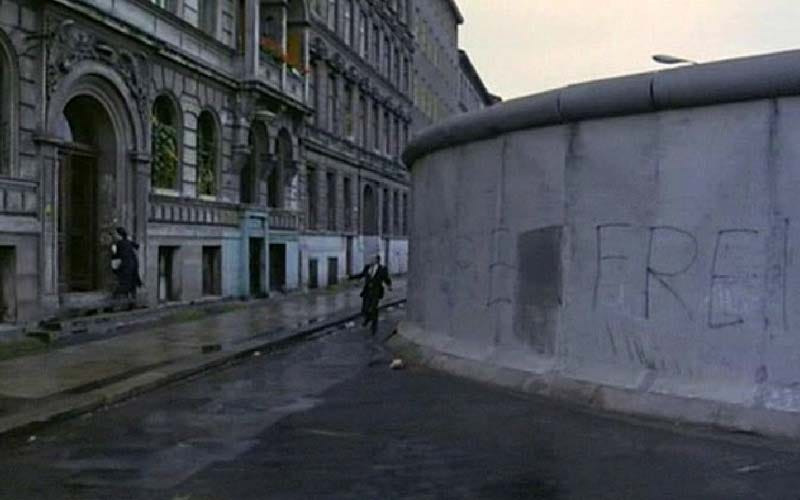
In the 1960s, D.W. Winnicott introduced a more politicised urban metaphor for psychic life. In his 1963 paper ‘The Value of Depression’ Winnicott likened the inner world of an individual to a map of Berlin, separated by the Berlin Wall, ‘symbolizing a locus for the world's tensions.’ The wall had been erected just two years earlier.
Winnicott’s imaginary map of Berlin is not just made of paper. It also has a fog hanging over it, which represents the depressed mood. The fog is deadening and impedes the individual’s relationship with the external world. If the weather changes, then the fog can lift but even beneath a clear blue sky the boundary remains. He claims the two sides of the psychic city represent ‘good and bad internal elements,’ though he isn’t explicit whether he believes this moral dichotomy has a direct counterpart in the two regimes in Germany. Although the dividing line is a constant presence, it is not completely impermeable; some exchanges between the two opposing sides still take place:
…like the chink in the Wall at Christmas time. The mood lessens in intensity and life begins again, here and there, where tensions are less. So rearrangements take place, an East German escapes to West Germany and perhaps a West German transfers over to the East. Somehow or other exchanges occur.
Winnicott acknowledges the limits of his metaphor: in the human psyche, unlike in Berlin, the wall itself might actually shift from time to time.
The same metaphor returns in his strange, digressive paper ‘Berlin Walls’ (1969). At times, as in ‘The Value of Depression’, the Berlin Wall is invoked as a metaphor for the depressed individual who cannot achieve integration, while at others it seems he is trying to gain insights into the psychic origins of the kinds of social and political divisions that lead to the erection of literal walls. The problem Winnicott keeps crashing into is that he can’t quite decide if social conflict is an analogy for psychic conflict or vice versa and as he is interested in conflicted societies composed of conflicted individuals perhaps metaphor is inevitably inadequate. His attempts to describe internal conflicts in metaphorical terms are smudged or strained as soon as he acknowledges that people live in, shape and are shaped by the social worlds they inhabit: ‘it is not only that there is always conflict in the social milieu, but also that conflict is invented and maintained by the individuals that compose society.’
He repeats an image from ‘The Value of Depression’: of an individual as a circle with a line down the middle. Here, however, he stipulates that this is not a universal description but applies specifically to the ‘healthiest conceivable human being’. Such a person is able to contain conflict and stave off the ‘war’ that threatens to erupt along their dividing line. No-one is completely without such a line but the ‘depressed state’ of a ‘normal’ or ‘healthy’ person is capable of tolerating the possibility of war along it without letting conflict fully erupt. Here he also invokes ‘the army’s peace line in Belfast’ as another example of what he insouciantly calls ‘the temporary success of a dividing line between opposing forces.’
Writing in November 1969, just three months after the Battle of Bogside in Derry and rioting in Belfast (in response to which peace walls were erected), the casualness of Winnicott’s tone is jarring: does an understanding of internal psychic conflict as something that can be contained but not eliminated inevitably have as its counterpart a blithe acceptance of any form of social antagonism? Don’t these metaphors naturalise the historical situations in Berlin and Belfast? Don’t they also threaten to render all political conflicts and the opposing forces within them weirdly interchangeable, downplaying power imbalances by assuming such relationships are characterised by mutual hostility rather than asymmetrical relations of oppression?
Winnicott soon strays into a more general discussion of national borders, which he describes as sites of strain: ‘Much of what we call civilization becomes impossible the nearer we get to the customs barrier’. Yet, for Winnicott, maintaining ‘civilization’ relies on those barriers. Their existence may demonstrate that civilization depends on violent exclusion, but they are also seen to reduce violence by keeping it at bay. As in Freud’s writings, civilization is an ambiguous concept, neither valorised nor denounced but accepted as a kind of lesser evil, a necessary empirical backdrop, its constitutive barbarism tolerated, which seems to involve a process of simultaneous acknowledgment and disavowal. Winnicott’s detached and impartial view of civilization made me think of Irish socialist republican Bernadette Devlin’s maiden speech in the House of Commons, delivered in the spring of 1969, in which she pointed out that ‘the so-called impartial forces of law and order’ in Northern Ireland were anything but.
For Winnicott, a border or frontier represents ‘the toleration of antagonism without denial of the fact of antagonism’, which he frames as ‘productive in a positive way.’ Borders are not exactly good, but the implication is that a world without borders would be even worse, leading to unbridled violence. Some peculiar paragraphs follow in which different forms of social division or domination pile up haphazardly: he muses on the psychology of dictators, the division between Catholics and Protestants in Ireland, on the borders between England and Scotland, and England and Wales. He half acknowledges that his paper is unravelling, that his examples lack precision or depth: ‘In every case anything stated briefly must be very poor in terms of truth, because the truth is complicated and therefore interesting and is rooted in history’ (lol, OK Donald).
Early in the paper Winnicott had declared: ‘It must be assumed that the world… cannot be better than the individuals that compose it.’ He concludes by returning to the Berlin Wall, which he seems to see as a useful reminder of the conflict that characterises psychic life, of a ‘willingness to postpone resolution of the conflict and to tolerate the uncomfortableness of the mood.’ A wall is preferable to an all out war. Peace isn’t really an option. If the world cannot be better than the people in it, then Winnicott’s vision of the psyche as a site of conflict that needs to be constrained is incompatible with a political vision that would seek to demolish borders, that would insist that some forms of political or social division should not or cannot be tolerated.
I find myself wishing that his descriptions of containing conflicts in the psyche could be prised apart from the assumptions he makes about social conflict as a consequence. Maybe that’s just saying I wish the world could be better than the individuals that compose it or maybe it’s an acknowledgement that even though individuals fight them, social conflicts cannot be understood simply as either an analogue or manifestation of internal psychological conflicts.