Coerced change
Robert Jay Lifton, 1926-2025
The psychiatrist Robert Jay Lifton died on September 4 2025. He was 99 years old.
Last year I published this review essay, ‘Psychic Numbing’, discussing two recent books in which Lifton plays a key role.

Nuclear Minds by Ran Zwigenberg argues that Lifton was not (as he claimed) the first psy-professional to work with survivors of the atomic bombings of Hiroshima and Nagasaki, while Combat Trauma argues that Lifton’s later work with anti-war Vietnam veterans had a political dimension that got lost in some subsequent conceptualisations of PTSD.
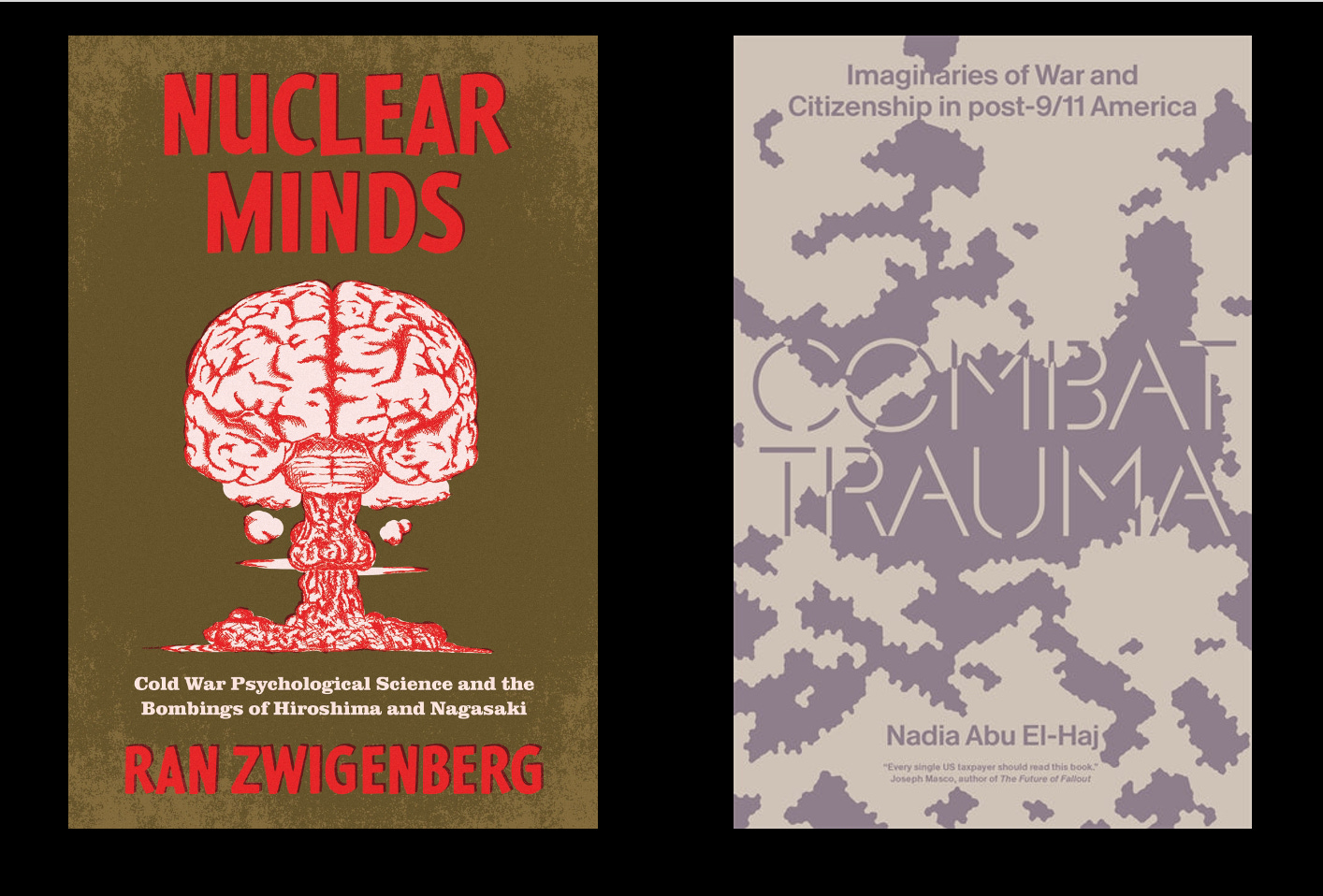
Zwigenberg’s book is mostly concerned with Lifton’s Death in Life: Survivors of Hiroshima (1967), Abu El-Haj’s with Home from the War: Vietnam Veterans, Neither Victims nor Executioners (1973).
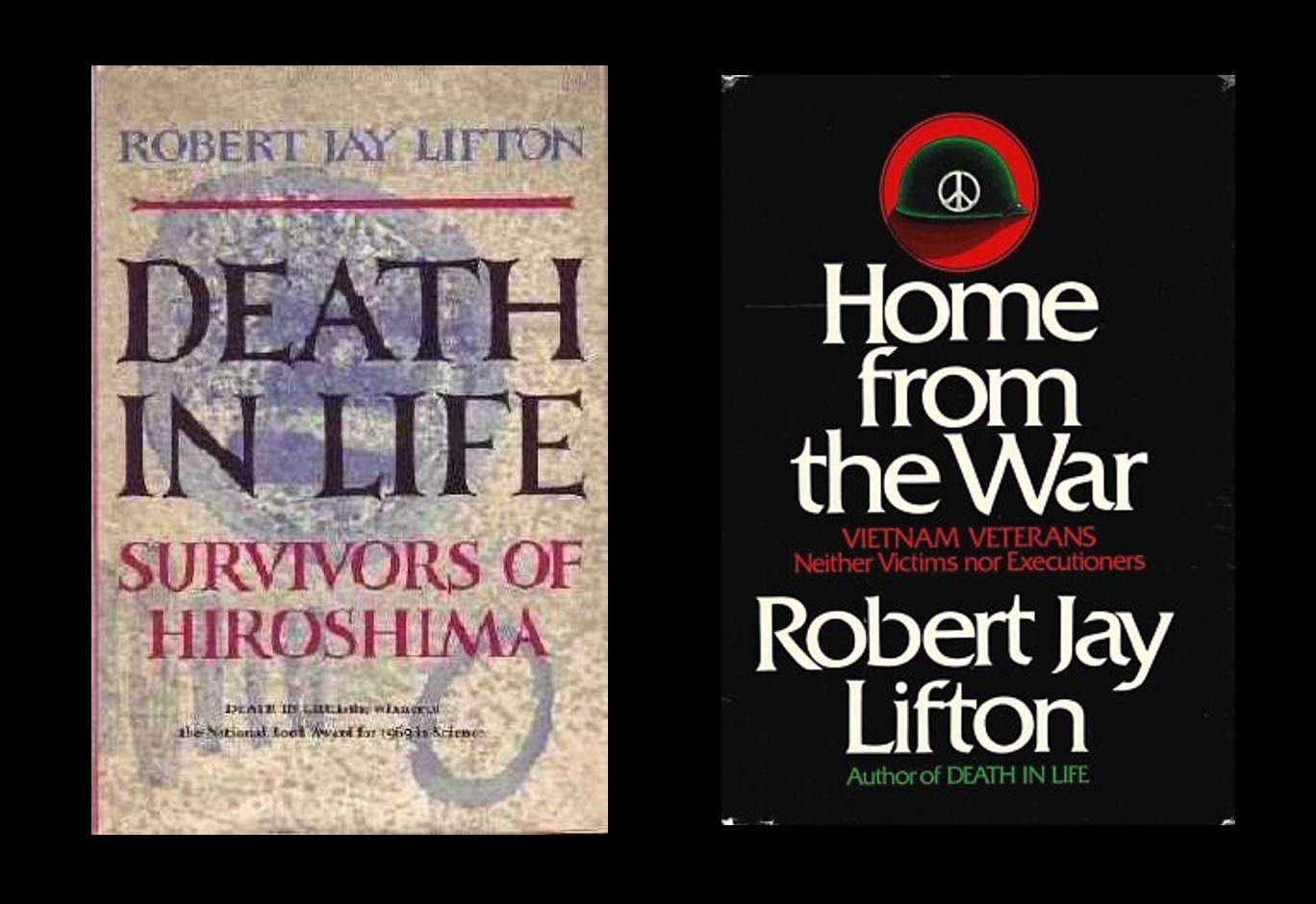
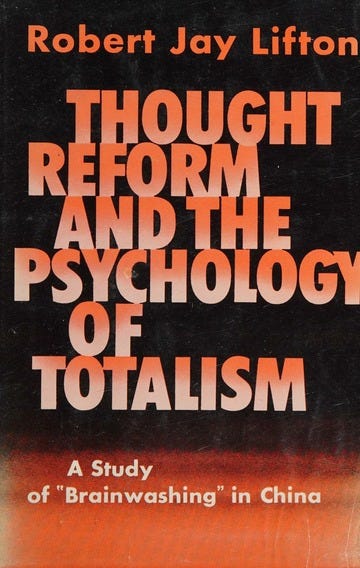
Lifton was a member of the Wellfleet psychohistory group, participated in the working group that led to PTSD entering the DSMIII as a diagnostic category in 1980 and was a campaigner against nuclear weapons. He published further books on Nazi doctors and cults, as well as an autobiography and various other things united by his ‘preoccupation with the interplay of individual lives with the larger fluctuations of history.’ But I have recently been doing some research on one of his earlier books: Thought Reform and the Psychology of Totalism: A Study of ‘Brainwashing’ in China, first published in 1961 and based on research conducted in Hong Kong in 1954.
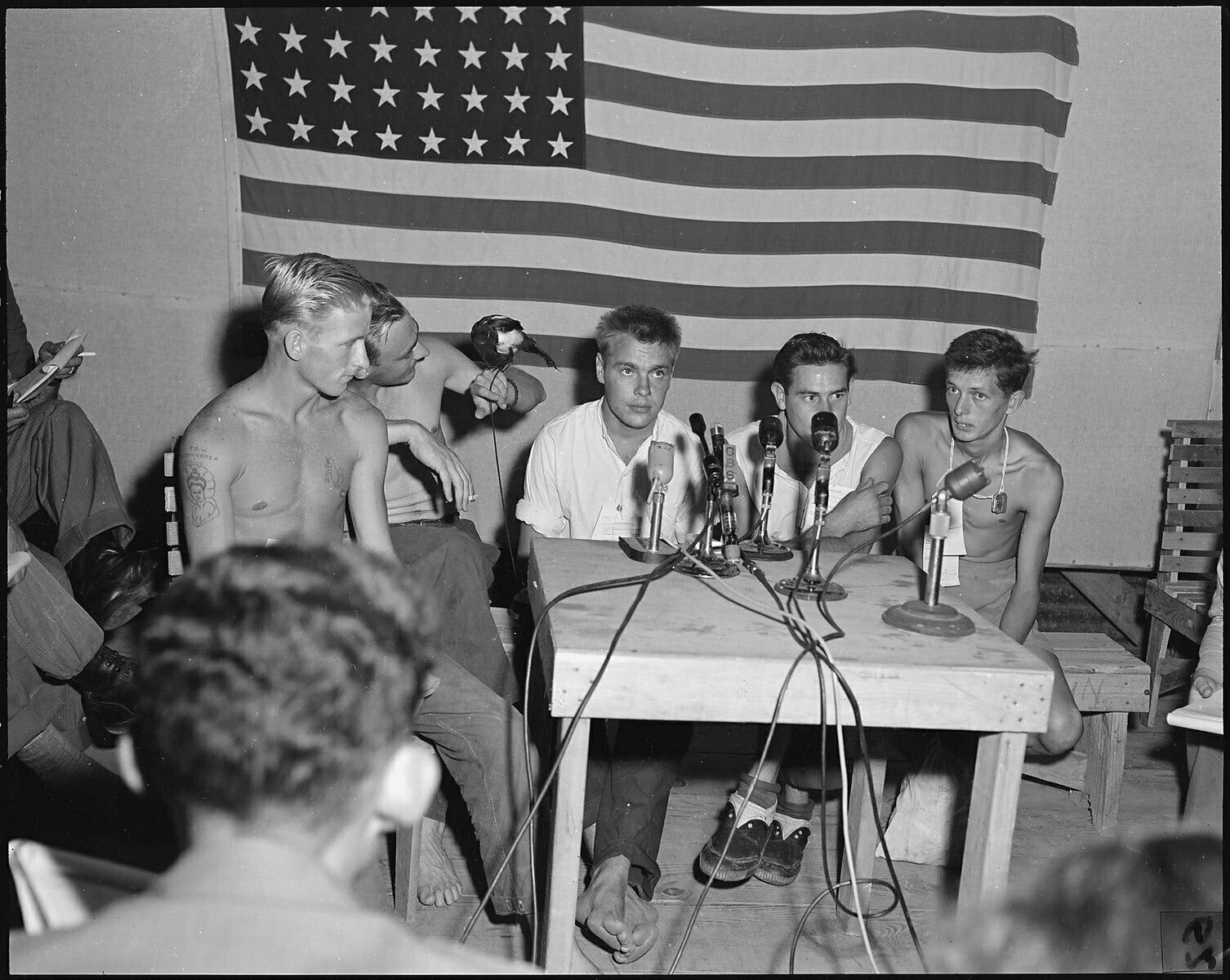
The term ‘brainwashing’ was coined by the US American journalist and propaganda expert Edward Hunter during the first year of the Korean War in 1950. He wrote about the Communist Party’s attempts to re-educate the masses following the Communist Revolution in 1949 and saw ‘brainwashing’ as a new technique for governing the mind with potentially global ramifications. Brain-Washing in Red China: The Calculated Destruction of Men’s Minds was published in 1951. Historians still debate the extent to which Hunter was involved with the CIA and whether ‘brainwashing’ was a direct translation from Chinese sources or an anglophone invention. Regardless of its precise origins, the term entered the US Cold War vernacular to signal a sinister form of ideological indoctrination that represented a major threat to capitalist liberal democracies. Hunter compared brainwashing to witchcraft and, as Daniel Pick argues, ‘reached for metaphors and analogies that, far from pin-pointing the science, in fact made [the practice] seem truly scary, and also tantalisingly vague.’ In 1952, stories of ‘brainwashed’ US Prisoners of War captured in Korea began to emerge, some of whom refused repatriation. For Hunter, according to Pick, the ‘question… was whether the prisoner/patient in latter-day regimes such as Stalin’s or Mao’s could ever resist, and what tools could be offered to make people more wary, critical or resilient.’ How could psychological resistance be fostered so that people would be immune to Communist ‘brainwashing’?
Confessions of past errors
Critical of the ‘lurid mythology’ that surrounded these rumours of ‘brainwashing’ of POWs in the aftermath of the Korean War, Lifton set out to understand individuals’ emotional experiences of thought reform. He later recalled:
I did not believe that the passions and confusions stirred up by thought reform could be represented by psychiatric categories (neurosis, psychosis, character disorder), and that was the beginning of a general disinclination to apply such categories to people responding to larger forces and in that way overclinicalize the world. I was trying to make use of my background as a clinician to identify psychological experiences of people caught up in historical storms.
In spring 1954, Lifton, then aged 28, who had just been discharged from serving as a psychiatrist in the US Air Force (after doctors were drafted into the Korean War), was briefly living in Hong Kong. The previous year he had conducted interviews and group therapy sessions with POWs being repatriated from Communist captivity in North Korea as part of a military team of psychiatrists. He wanted to pursue similar work outside of a military setting to learn more about thought reform so while in Hong Kong he interviewed Westerners – including many missionaries - and Chinese people – mostly students and intellectuals - who had undergone ‘thought reform’ in the People’s Republic of China. He obtained funding from the Committee for a Free Asia, which he claimed he only much later learned was sponsored by the CIA.
Lifton interviewed people for between fifteen to forty hours each – 50 Westerners and 15 Chinese students and intellectuals – and found that the thought reform methods used for each group were different, with the Westerners more likely to have been physically abused and tortured. In a project outline he wrote to apply for more funding after completing a small number of pilot interviews, he noted that with the Westerners the focus was on extracting a ‘confession’, whereas the Chinese intellectuals underwent ‘a program of intense scrutiny and criticism of the individual’ in group discussion meetings.
‘Confessions’ of past ‘errors’ are stressed, but these are considered only milestones in a process which aims at bringing about a profound internal emotional upheaval in the individual in order to recreate his personality in the Communist image.
He noted that in some cases the interviews he conducted seemed to remind his interviewees of their previous experiences of ‘confession’ or self-criticism. These encounters were not strictly therapeutic but Lifton writes that he nonetheless ‘sensed the importance of bringing a healing spirit to the encounter.’ In his memoirs he recalled:
The reformers employed considerable coercion, sometimes violence, but also powerful exhortation on behalf of a new Chinese dawn, seeking to bring the beliefs and worldviews of participants into accord with those of the triumphant Communist regime. I could observe that thought reform was by no means a casual undertaking but rather a systematic and widespread program that penetrated deeply into people’s psyches and raised larger questions about the mind’s vulnerability to manipulation and coerced change.
Lifton found some of his own assumptions challenged by the people he interviewed: a French missionary though critical of the brutality of the methods seemed to remain intellectually convinced about the anti-imperialist arguments against the role of missionaries that he had been introduced to through thought reform. Lifton also learned to adapt his methods depending on who he was interviewing. A seventy year old bishop from Belgium who had been subjected to physical abuse in Chinese prisons insisted on questioning Lifton about his Jewishness and so their own exchange had a theological dimension.
Lifton was deeply troubled by the phenomenon of the ‘false confession’ and was disturbed as much by the capacity for people’s minds and attitudes towards the truth to be altered as he was by the cruelty and violence involved in thought reform practices.
Resisting thought reform
In his preface to the book’s second edition, Lifton reflected that he had come to see it not just as a book about thought reform in China but about the broader ‘quest’ in the twentieth century ‘for absolute or ‘totalistic’ belief systems.’ He linked his work on thought reform to his later interest in religious fundamentalism and cults. He defined the goal of thought reform as a kind of total erasure of past experiences, as a wholesale remaking of the subject:
I came to view the process as an apocalyptic cleansing of all the past—a psychological apocalypticism in which all prior products of the human mind had to give way to a new collective mind-set that was pure, perfect, and eternal.
For Lifton that drive to purity and perfection is what leads to dogmatism: it’s completely uncompromising. One of the animating questions of his book is: ‘Can a man be made to change his beliefs?’
One of his cases, who he refers to as Father Luca, is described as having resisted giving a false confession and responding to the reformers with ‘forthright defiance’ (although he did eventually ‘confess’ after undergoing intense sleep deprivation and long interrogations). Lifton suggests that the methods were so intense that resistance became impossible – ‘This penetration by the psychological forces of the environment into the inner emotions of the individual person is perhaps the outstanding psychiatric fact of thought reform.’ Later he claims that the way thought reform forces the subject to completely transform themselves and their understanding of the world produces a form of psychosis: ‘one cannot have his deepest feelings about who and what he is totally replaced, and still survive in a nonpsychotic state.’
Lifton divided the Westerners he interviewed into three categories: ‘the obviously confused, the apparent converts, and the apparent resisters’. Here the adverbs and adjectives are as significant as the nouns. The latter group – ‘apparent resisters’ - were those who immediately condemned thought reform as soon as they’d crossed the border to Hong Kong. But Lifton observed that their resistance was not ‘nearly so complete as their external expression suggested’. He describes the case of a Belgian bishop who discussed the methods he used to resist thought reform but who gradually admitted he had made many concessions to the process – ‘Even as he condemned the Communists, he was deeply impressed with their power and energy, and compared these favorably to the shortcomings of the West in general and of the Catholic Church in particular.’ This reminded me of an anecdote of an undercover FBI agent sent to spy on the Black Panthers who later admitted to having found their work ‘powerful, inspiring and beautiful’.
As a self-proclaimed liberal, Lifton defined resistance as an affirmation of individualism, but his book also considers people who were being introduced to the tenets of a communist ideology that framed resistance as a necessary collective struggle against the ‘bourgeois remnants’ of the old regime and who found themselves questioning some of their previous assumptions and behaviours. I would be tempted to suggest that the phenomenon of the ‘apparent resister’ isn’t as contradictory as Lifton seems to think: it is obviously possible to believe that imperialism is oppressive, that capitalism is exploitative, that Chinese peasants were mistreated by their landlords without therefore endorsing the most violent thought reform methods. That Lifton doesn’t draw this conclusion, I think, is because he isn’t really interested in the content of Communist ideology. He is interested in dogmatism or totalism as such. This is what allows him to treat different forms of ‘totalism’ as effectively interchangeable. Obviously for the bishops he was interviewing Mao and God were not interchangeable but for Lifton puritanical belief in either has an identical form and function. This means that he isn’t really able to grasp that some aspects of the Marxist anti-imperialist thought that his interviewees encountered might have been distinguishable from the brutal practice of thought reform. (Interestingly, his later book Revolutionary Immortality, published in the period of the Cultural Revolution, which analyzes works by Mao makes slightly different arguments.)
Lifton compared the dogmatism and fear-mongering that characterised Chinese thought reform to US McCarthyism – a contemporaneous phenomenon – arguing that fervent communism and fervent anti-communism mirrored one another in certain ways, in that both had a paranoid and totalising logic. But I’m interested in a more surprising analogy that he makes in his book: between Chinese thought reform and psychoanalysis. Through his interviews in Hong Kong Lifton began to ask questions about the difference between ‘coercive and therapeutic change’, which were central to his own role as a clinician. Lifton’s interest in thought reform was entangled with his contemporaneous interest in psychoanalysis. Just as some of the bishops he interviewed found certain Marxist ideas appealing, Lifton was drawn to many psychoanalytic concepts and insights but was ‘appalled by its frequently dogmatic tendencies.’
Resisting psychoanalysis
Lifton began training at the Psychoanalytic Institute in Boston while he was writing up the results of his Hong Kong research in the mid-1950s. In his 2011 memoirs he reflected that his work in Hong Kong, ‘sensitized’ him to ‘milder expressions of totalism and near totalism.’ His experience of psychoanalytic training was one such case. In this orthodox Freudian environment Lifton found the atmosphere ‘highly authoritarian’. He claims he wrote a discussion of the resemblances between Chinese thought reform and psychoanalytic training into his book in response to these experiences, framing these sections of the book as a ‘considerable act of rebellion.’
Lifton resisted psychoanalysis and resisted the psychoanalytic interpretation of that resistance. Soon after publishing his book, he decided to terminate his training. His own resistance to psychoanalytic orthodoxy, he argued, enabled him to develop more creative readings of Freud but it was also a rebellion that severed him from the profession.
According the Lifton, the ‘ethos of psychoanalysis and of its derived psychotherapies is in direct opposition to that of totalism… Because of its continuing concern for individual differences and for flexible personal development, it is not surprising that psychoanalytic work has never been permitted under totalitarianism’ [a debatable claim but let’s not get into that now]. He goes on to say that psychoanalysis nonetheless has had ‘its full share of bitter ideological controversy and schism’. He describes psychoanalytic training in terms similar to those he uses to describe thought reform: as a process of re-education. He questions if psychoanalytic training – in which a trainee is both a student and a patient - leads to ‘milieu control’, relying on an ‘implicit demand for ideological purity’ and ‘intellectual conformity’. Of course, he hastens to add, psychoanalytic training isn’t as totalising as thought reform – psychoanalysts don’t generally beat their trainees up, handcuff them or deprive them of sleep – but he still insists on pursuing the analogy further.
One of the main points of comparison for Lifton is the concept of ‘resistance’:
Chinese reformers are apt to consider any inner opposition or outer hesitation—in fact anything at all that stands in the way of thought reform—as "resistance." The psychotherapist similarly regards almost any attitude or behavior standing in the way of cure—but especially the reluctance to bring unconscious ideas into consciousness—to be expressions of resistance to therapy. These resistances are the real experience of any therapist; but after a study of thought reform one cannot help but be a bit chastened in the use of the concept. That is, as a psychotherapist I would consider it important to ask myself whether what appears to be resistance is truly a reflection of inner opposition to cure, or whether it might be inner opposition to my concept of the necessary direction of cure. And I would also wonder whether such resistance might not be a reflection of poor communication between the patient and myself, or of the absence between us of shared values and assumptions about the therapy, both of which might be profitably investigated along with any psychological barriers within the patient.
In this scenario Lifton identified with the prisoner being subjected to thought reform who attempted to cling on to their own identity and refuse the worldview of the interlocutor…
This thought stops here in media res but I’m planning to write about this in more detail and depth in future…