World anti-fascist war
A postcard from China, 1945/2025
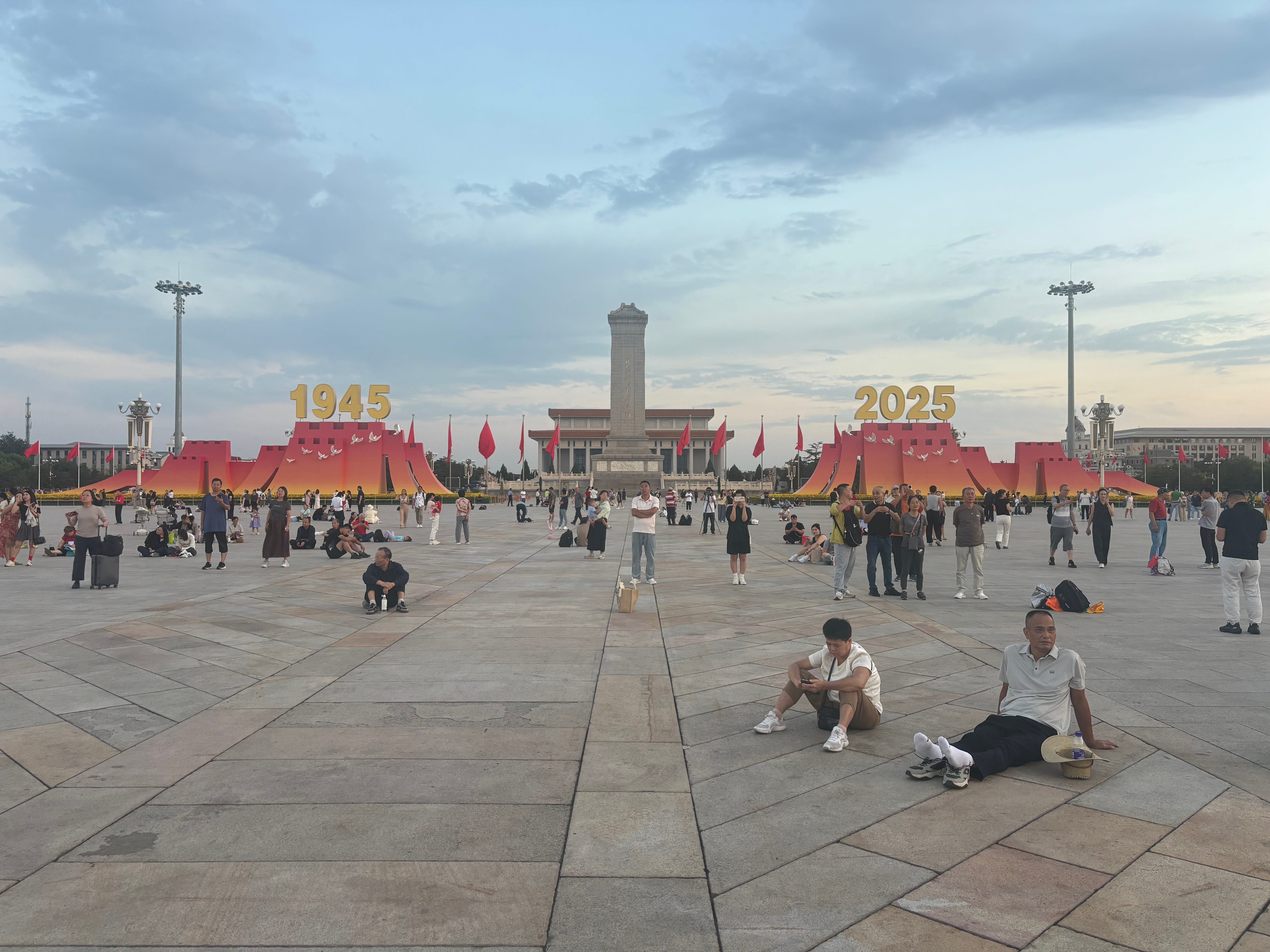
Shortly after I landed in Shanghai an official in the queue for the passport desk asked if I had proof that I had booked an outbound flight. I showed it to her. She asked if I was visiting China as a tourist. Yes, I said. Then she asked if I was visiting for September 3rd. I said: no. She explained that September 3rd was an important day, a very important day in China celebrating victory over Japan. She told me that it had been 80 years and that there would be a big military parade in Beijing. She reiterated that it was important. She told me to turn on the TV on September 3rd to see for myself.
The images I saw circulating of the parade on my social media feeds in its aftermath showed Xi Jinping flanked by Vladimir Putin and Kim Jong Un. I read detailed descriptions of the military equipment on display: supersonic missiles, underwater drones, an intercontinental ballistic missile, a vehicle-mounted laser weapon. The accounts from US and UK news sources that I skimmed framed the event as a display of China’s military might and geopolitical alliances, signalling the emergence of a ‘new world order’. I didn’t read anything about the event as a commemoration of the past but during my trip to China I kept stumbling into things relating to the Chinese People's War of Resistance Against Japanese Aggression and the World Anti-Fascist War, 1937-1945.
A few years ago I visited the Berlin-Karlshorst Museum, which is on the site of the Wehrmacht’s unconditional surrender to the Allies in May 1945. Used by the Soviet military until 1967, it became the Museum of the Unconditional Surrender of Fascist Germany in the Great Patriotic War 1941-1945, was renamed the German-Russian Museum in 1995 after the collapse of the USSR and was renamed again following Russia’s full-scale invasion of Ukraine in 2022. History never stays still. I was struck by a panel in the basement, which included a map showing Second World War casualties by country. I had a momentary feeling of vertigo looking at it. I remember feeling very stupid for never having realised how many people had been killed in the war in China – estimated to be approximately 20 million – and how little I knew about what happened during the war there.
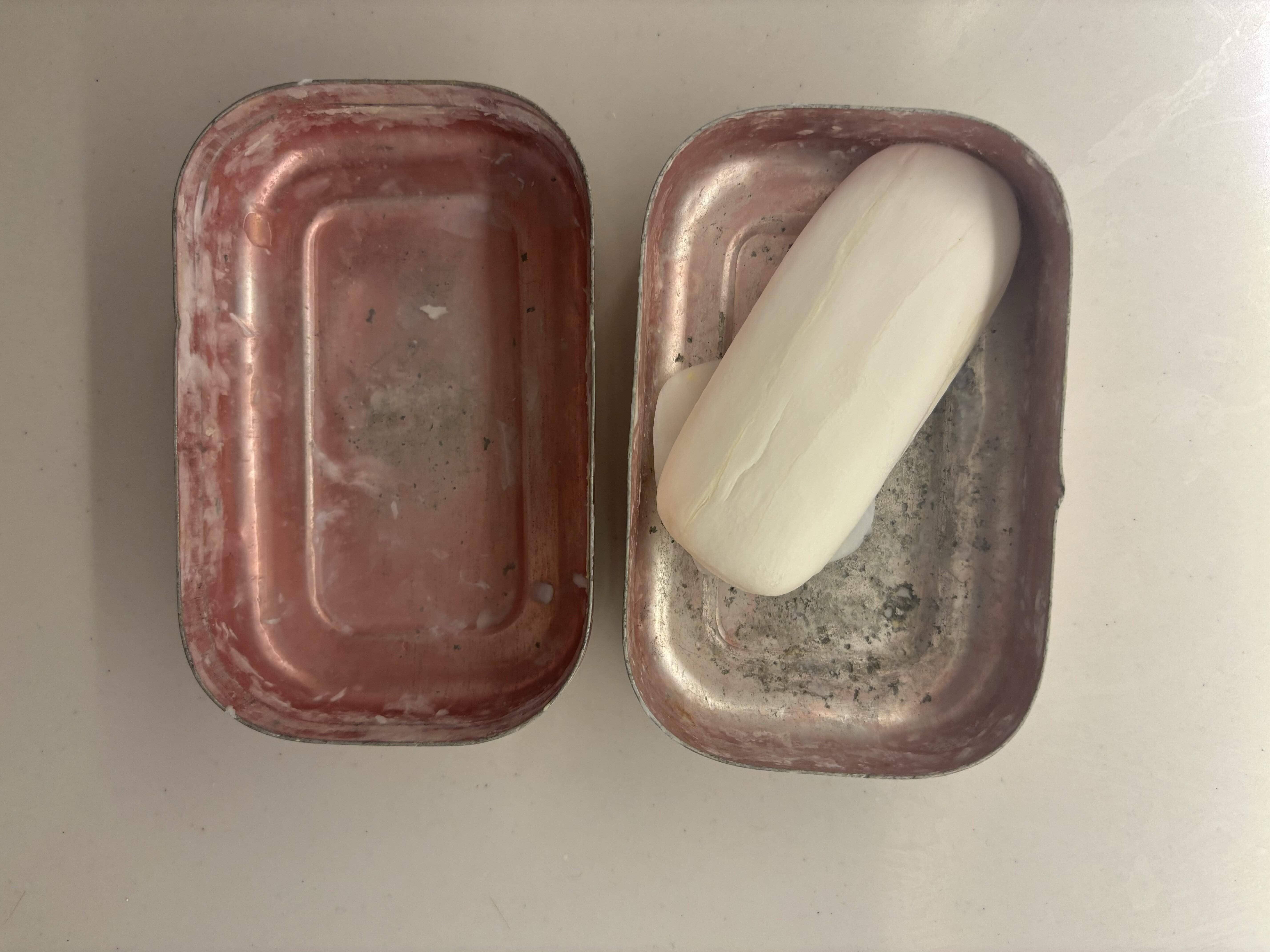
In Shanghai, I was staying with an old friend. In his shower I noticed that he still has a metal soap dish that I gave him years ago that previously belonged to my grandfather. The soap dish was issued to my grandfather when he was conscripted to serve in the British army during the Second World War. I only know small details about my grandfather’s experiences in the war. He was a teenager. He travelled on a boat that went down past the Cape of Good Hope. He fought the Japanese as part of the Burma Campaign in what is now Myanmar. He lost a friend who was shot and killed by Japanese soldiers in the jungle. He may or may not have shot and killed Japanese soldiers in the jungle. He caught malaria and spent most of the war recuperating on a camp bed somewhere in India. Now he was dead but his granddaughter and his soap dish were in Shanghai and it was the 80th anniversary of the defeat of Japan in the Second World War.
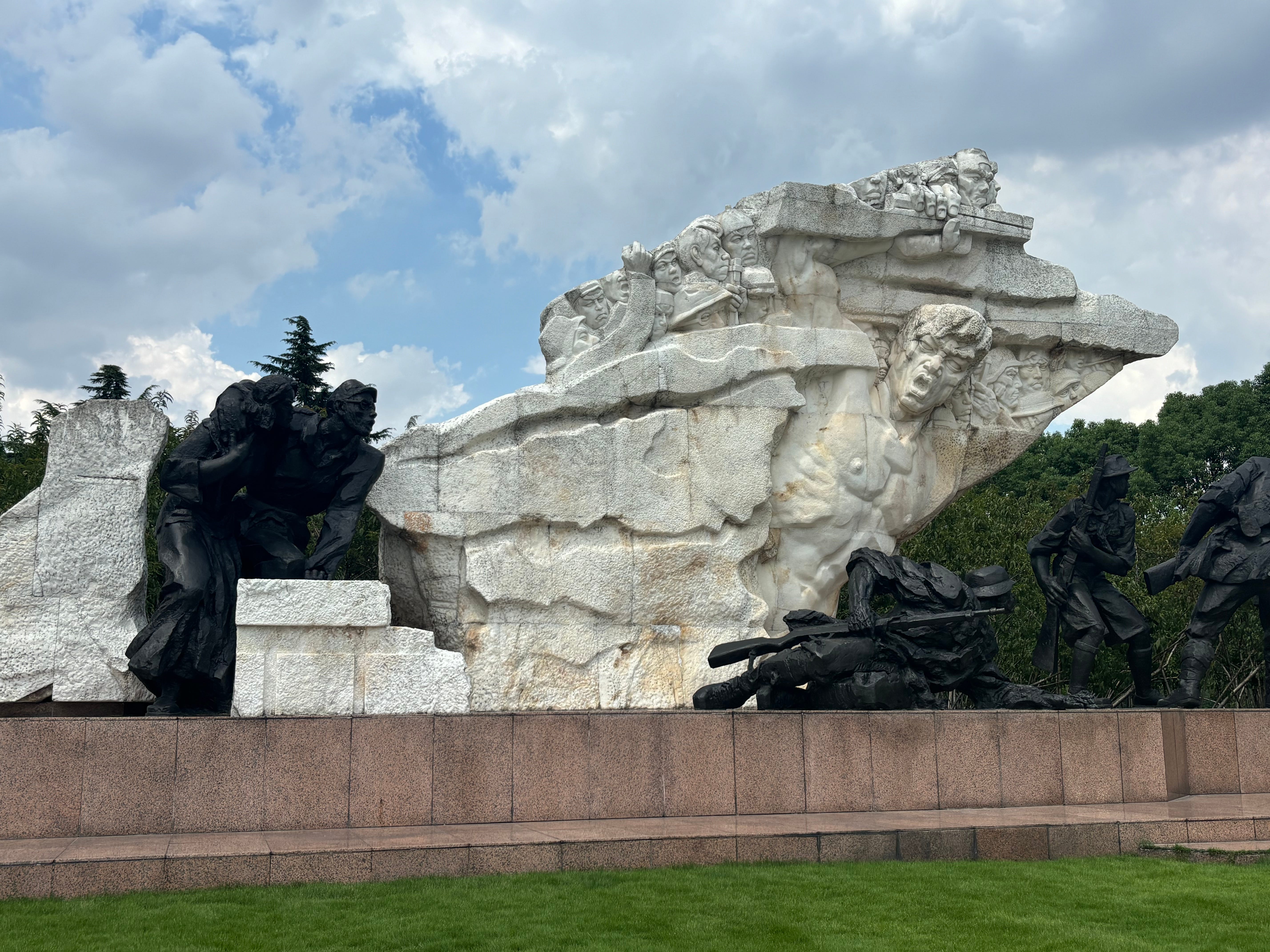
On September 3rd while the enormous military parade was taking place in Beijing, I visited the Longhua Memorial Park of Revolutionary Martyrs in Shanghai. I wandered among the trees and lily padded pools to look at the various statues and grave stones scattered across the grounds. The park is at the site of a former Kuomintang garrison where many Communists were murdered between 1927 and 1937. It includes memorials to various events. By one entrance stands a large war memorial called ‘Joint Fight Against Invasion’, commemorating military and civilian resistance to the Japanese. While I was sitting on a bench in the shade a group of young people stood in front of a central glass pyramid which houses a museum while the Internationale played from speakers poking out from the grass. After the song finished they lay flowers. It was unclear to me if this type of commemorative ritual took place regularly or if it was connected to September 3rd.
After leaving Shanghai I went to Nanjing where I visited the Memorial Hall of the Victims in Nanjing Massacre by Japanese Invaders. 1937: the height of the Stalinist purges in Moscow, the bombing of Guernica by the Nazi Germany’s Condor Legion and Fascist Italy’s Aviazzione Legionaria in the Spanish Civil War, the establishment of Buchenwald concentration camp in Nazi Germany. 1937 was also the year in which the Imperial Japanese Army occupied Nanjing (then known as Nanking). It is estimated that 300,000 civilians were killed in the Nanjing massacre.
Edgar Snow’s best-selling Red Star Over China was first published by the Left Book Club in 1937 and was responsible for introducing many British readers to Mao. That winter, Snow was in Nanjing as a reporter. He described the intensity of the killings and the widespread rape of Chinese women by Japanese soldiers in his later book Scorched Earth (1941): ‘Some 50,000 troops in the city were let loose for over a month in an orgy of rape, murder, looting and general debauchery which has nowhere been equalled in modern times.’
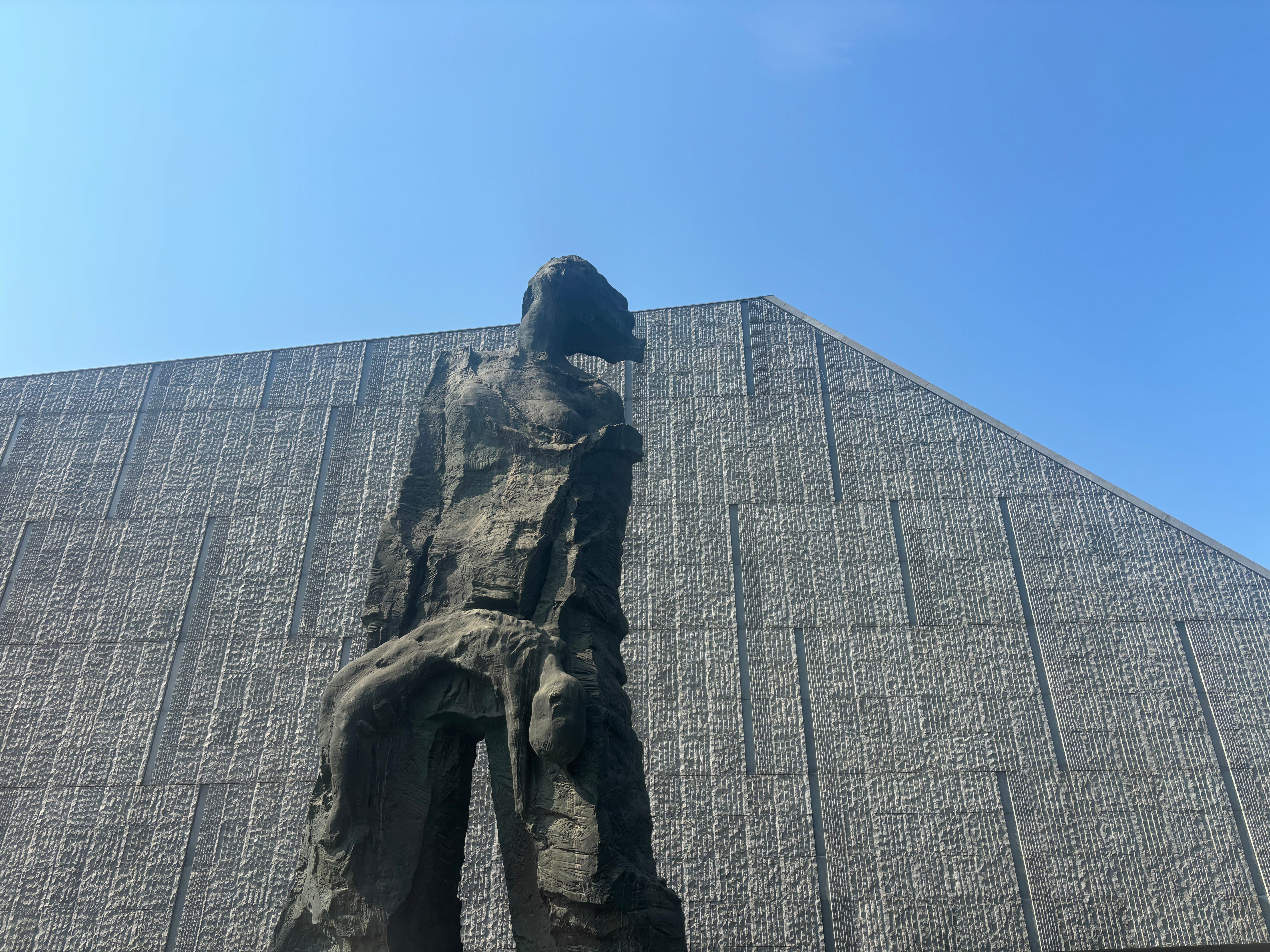
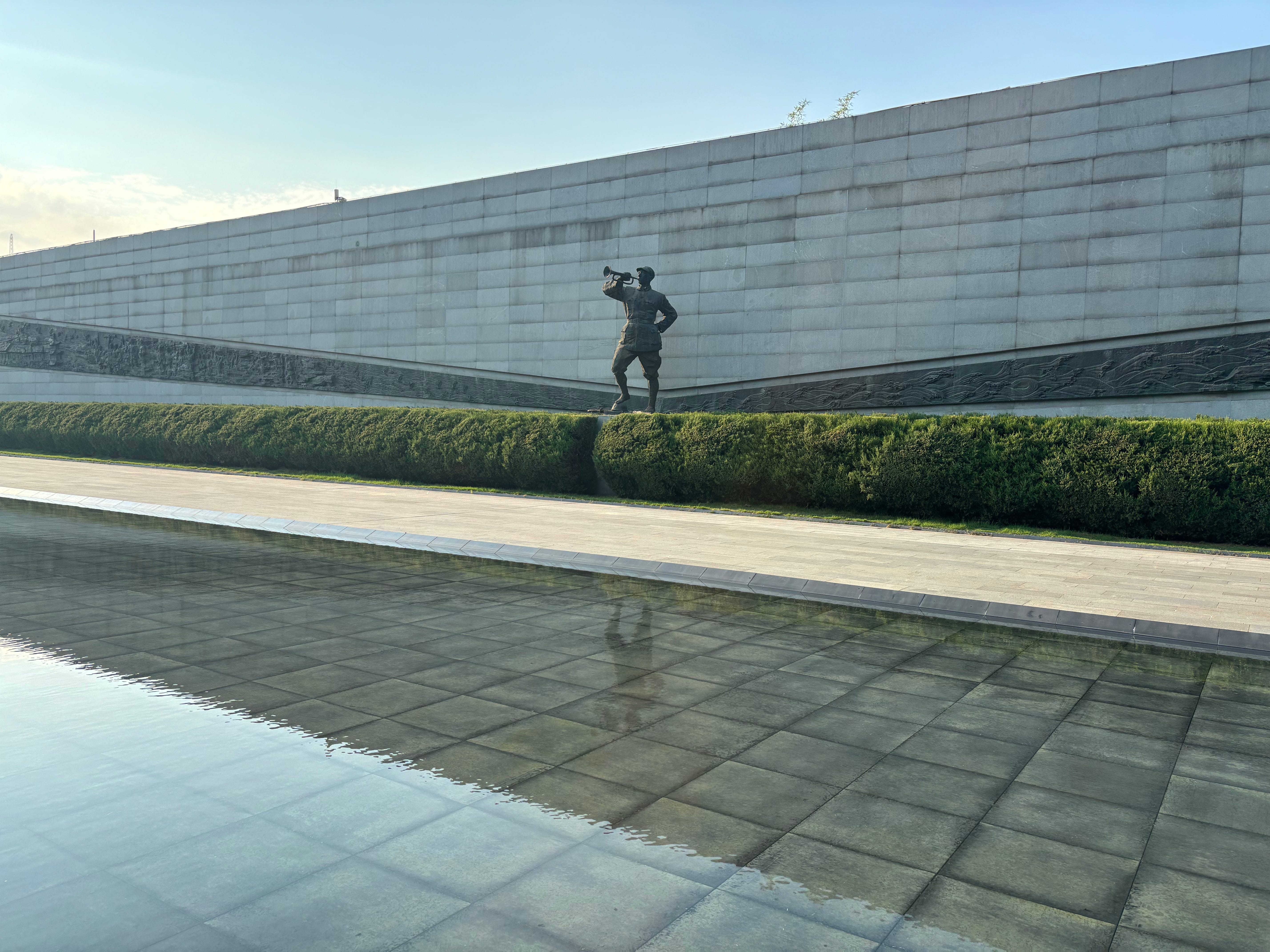
The memorial hall is part of a large complex including outdoor monuments, a chilling room of victims’ remains and an area for floral tributes. It was easily the busiest museum I have ever visited. There were long queues outside but I was the only person at the entrance for people without a Chinese ID. The main exhibition is in a large subterranean complex. Visitors descend a grand staircase into a dimly lit room lined with photographs of victims before proceeding through a detailed exhibition on the occupation, the atrocities committed by the Japanese, the subsequent relief effort and various military tribunals. The route ends with a ‘Sowing Peace’ gift shop where you can buy dove fridge magnets and purple stuffed toy flowers.
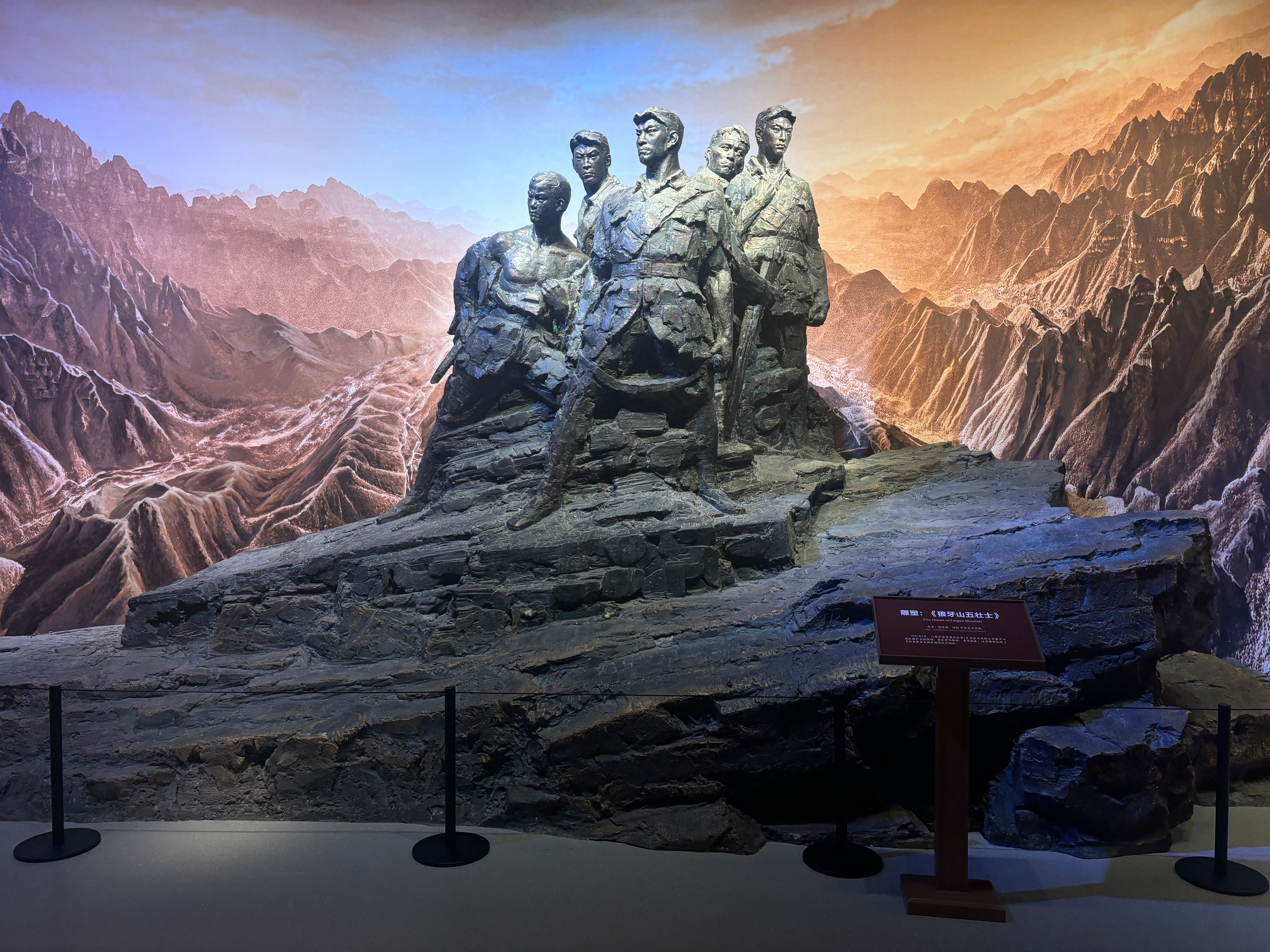
On a TV screen on the train from Nanjing, I saw an advert for The Museum of the War of the Chinese People's Resistance Against Japanese Aggression in Beijing. The next day I decided to visit. The museum is located quite far from the centre of Beijing in the Wanping Fortress, which was the site of the three day battle between the Imperial Japanese Army and the Kuomintang’s National Revolutionary Army of the Republic of China that marked the start of the Second Sino-Japanese War in 1937. As with the memorial hall in Nanjing, this museum was also very large and very busy, with extensive multimedia displays, dioramas, monuments and cabinets of artefacts.
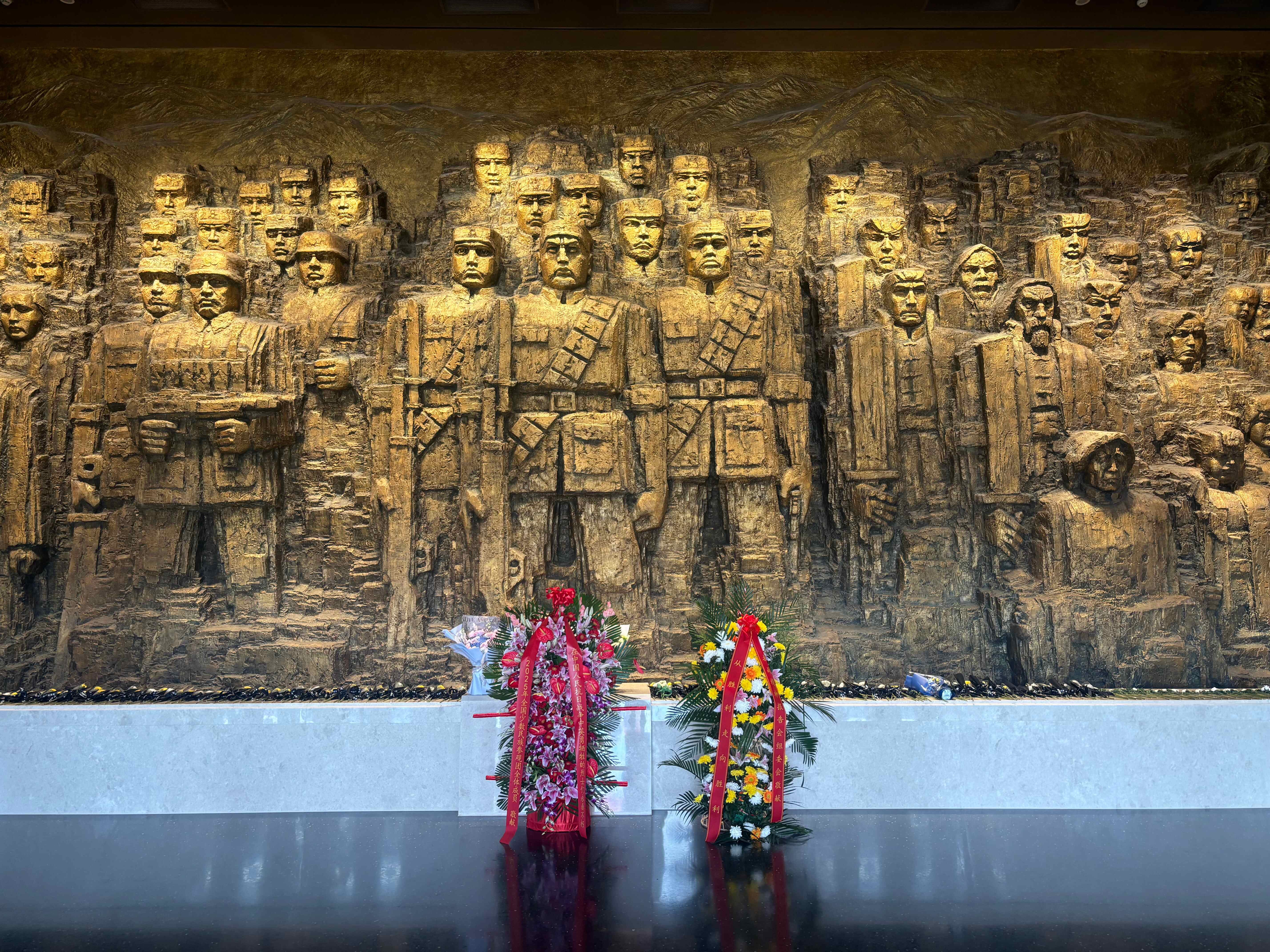
The narrative presented by the wall text in the galleries emphasises the heroic role played by the Communists in guerrilla warfare against the Japanese and credits them for later establishing a ‘United Front’ between themselves and the nationalist Kuomintang, presenting the Kuomintang’s role in the war as almost incidental (despite the fact they were then the ruling party).
The museums in Nanjing and Beijing both opened in the mid-1980s, during the period of ‘reform and opening up’ under Deng Xiaoping when historical narratives in China were shifting. Both museums accord a prominent place to Western collaborators, some of whom are presented in a heroic light. The Nanjing exhibition somewhat jarringly includes a whole display case of poorly contextualised certificates emblazoned with swastikas and Nazi eagles awarded to the German diplomat and Nazi Party member John Rabe by the Third Reich for his role in rescuing civilians during the massacre, while the Beijing museum contains displays relating to Chinese and British military cooperation during the Burma Campaign. There is also a section celebrating cooperation between China and the USSR and another devoted to resistance to the Japanese in Hong Kong, Macao and Taiwan.
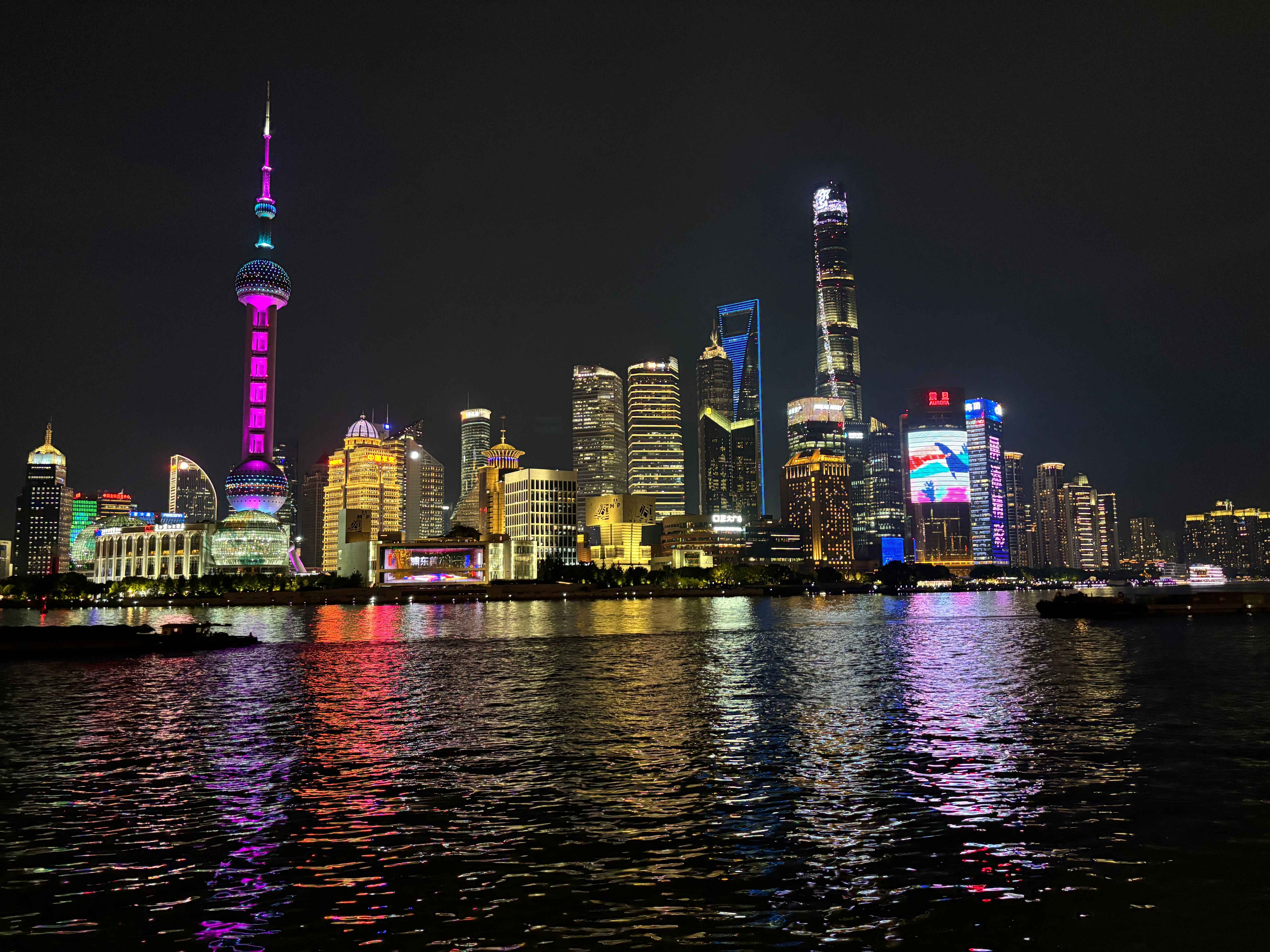
During my trip, I also happened to read J.G. Ballard’s autobiographical novel about his adolescent experiences in wartime Shanghai, Empire of the Sun. I have a strange relationship to Ballard’s work because I was friends with his partner Claire Walsh who I met when we were both MA students at Birkbeck in 2008. ‘Jimmy’ was still alive then but he was already sick and had moved from his famous house in Shepperton into her small flat in Shepherd’s Bush. She sometimes emailed me from Hammersmith hospital where he was being treated. They used to go to a Thai restaurant near her flat together which I remember visiting with her before he died as all the staff asked after him. I never met him. The day he died she emailed me and another friend from our course: ‘The saddest news: Jimmy died this morning at seven. I can hardly believe I’m writing this…’ My grandfather was a few years older than Jimmy but they died in the same year.
Claire had been in a relationship with Jimmy for decades by the time he died but they only lived together briefly at the very end of his life. They never married. They would speak on the phone in the evenings and spent most weekends and holidays together. He would drive up the West Way to visit her on a Friday night. Claire had a poster of the 1987 Steven Spielberg adaptation of Empire of the Sun hanging over her stairs in a frame that was never quite straight. A producer who was interested in making a documentary about Ballard’s early life contacted her at some point asking if she’d potentially be interested in going with him to visit Shanghai. She died in 2014 and never went to Shanghai but over the years between his death and hers she would occasionally return to the idea as a possibility and would sometimes send me links about things relating to the city. I never had much desire to read his work but – sixteen years after his death and eleven years after hers – I felt compelled to read Empire of the Sun in Shanghai and wandered around the Bund looking out for places he mentions in the early chapters of the novel.
Empire of the Sun is a novel of ‘strange dislocations.’ The book it most reminded me of was Samuel Delany’s Dhalgren with its isolated protagonist wandering the ruined and looted city under ominous skies. Ballard often remarked that his science fiction work drew on his childhood experiences in Shanghai. Drained swimming pools, empty cinema screens, an abandoned stadium. Fly-infested trucks, weevil-infested wheat, mosquitos hovering over stagnant pools. Burial mounds, carpets of bones, infected wounds. Dust, sweat, rust. Air raid sirens, open coffins, ‘incandescent debris’. Empire of the Sun is full of the physiological and material detail of war and conveys not only the rhythms of life in an internment camp but the fragility of the opulent colonial world the protagonist Jim had grown up in – ‘He wanted to shout to them: The world has gone away!’ The once solid-seeming social world that had been taken for granted is quickly destroyed. Rotten cocktail cabinets and overgrown lawns.
In Shanghai, we watched the TV documentary Shanghai Jim in which Ballard returns to the city of his birth in the early 1990s to find the architecture of the Bund almost completely unchanged. Returning to the small room filled with bunkbeds in the former internment camp he and his family had been imprisoned in for three years he declares himself at home. The waterfront buildings that were once in the International Settlement remain today but the city skyline is completely transformed.
In the interlude between the end of the war and the revolution in 1949 Jim returns to his house in Shanghai where the family’s chauffeur returns to work for them. Jim claims he had absolutely no idea what the driver had been doing during the war, speculating that he could have worked ‘as a valet to a Chinese puppet general, as an interpreter for the Japanese, or as a Kuomintang agent working on the side for the Communists’. He would have known even less about his subsequent experiences. Ballard’s Chinese contemporaries who remained in Shanghai and lived through the revolution and founding of the PRC, the Great Leap Forward, the Cultural Revolution, and subsequent economic reforms would presumably have had very different perspectives to him on ‘strange dislocations’ and experiences of dramatic material upheaval.
Both the Nanjing and Beijing museums conclude with messages extolling peace in language that was also echoed in President Xi’s speech at the military parade. At the end of the exhibition in Nanjing, a sign on the wall says that the massacre
…should be remembered by the whole human race to inspire everyone with a kind heart to yearn for and safeguard peace, increase the awareness of building a human community with a shared future, abandon prejudice and discrimination, eliminate hatred and war, and promote mutual respect, equality, peaceful development, and common prosperity.
While in Beijing the final wall text proclaims: ‘The Chinese people love and cherish peace. Their unforgettable memories of the sufferings brought by war urge them to persistently pursue peace.’
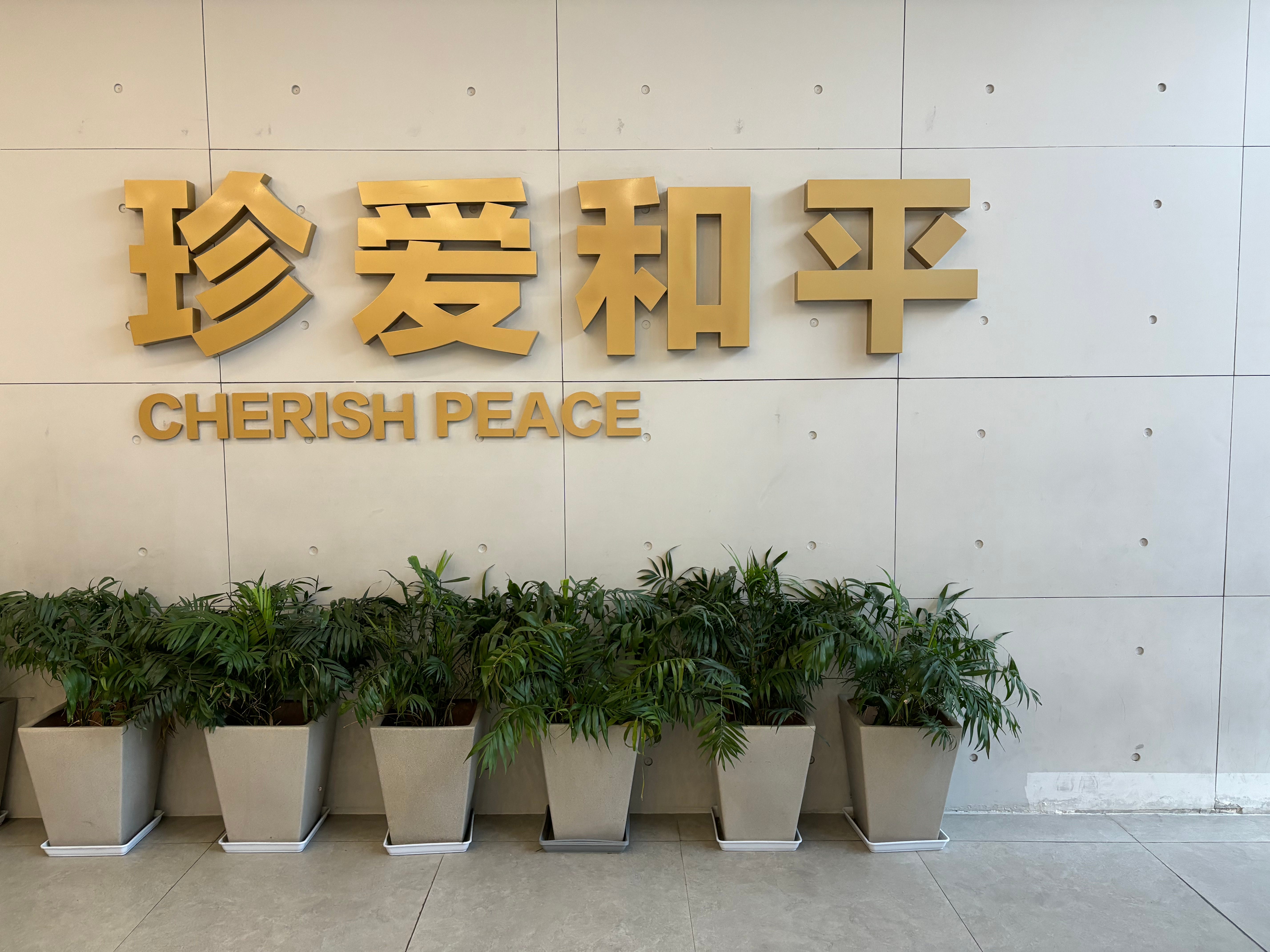
China was last at war in 1979 but the official rhetoric of peace sits uneasily alongside bombastic displays of military force, just as a proclaimed commitment to world anti-fascism might seem hollow when welcoming political figures like Putin and Modi (the latter skipped the parade but was in China immediately beforehand). Unlike many of the states who were absent from the September 3rd parade, China is not directly complicit in Israel’s genocide, has supported UN resolutions critical of Israel’s actions in Gaza, and has publicly condemned Israeli military actions but economic ties between China and Israel persist.
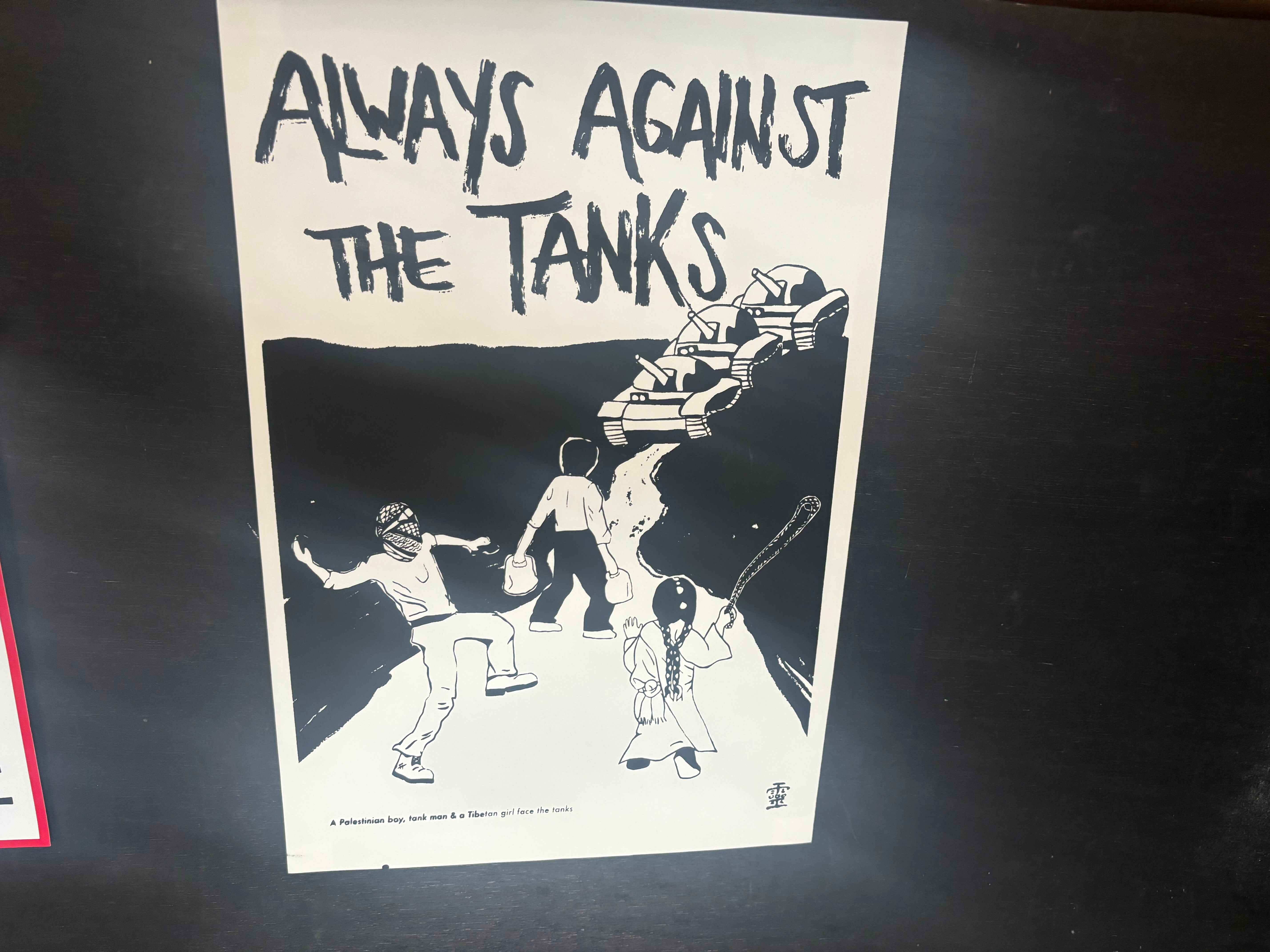
Before returning home I spent a few days in Taipei. On the morning before my flight I attended a small bake sale for Gaza at the New Bloom social centre. In contrast with the peaceful platitudes of the Sowing Peace gift shop, I saw a poster with the slogan ‘Always Against the Tanks’, which showed an image of the anonymous ‘tank man’ who stood in front of the tanks in Tiananmen Square in June 1989 alongside a Tibetan girl with a club and a Palestinian boy throwing a rock. The poster does not simply declare a commitment to peace but shows there can be no peace without resistance to unjust force.
This is a beautifully written piece. Thank you so much for sharing. I hope that you will allow me to share some thoughts drawn from my personal experiences. I hope that you will find them relevant, or that you will forget me thoroughly if they are too cringe or stupid.
My maternal grandfather was born in Manchuria. He was part of a family of 8 siblings. When the Japanese occupied parts of Manchuria in the 1930s, his family escaped south, ultimately settling down in Jiangxi province near Ji’an. By the time they arrived, only he, his mother and his younger brother survived. All the rest of them died along the way from one kind of violence or another.
My mother didn’t experience this history firsthand. Yet, she held onto an inherited hatred of the Japanese — its government, its people, and its culture — despite having actually met and befriended a Japanese coworker named Shoji after our family emigrated to the US. When Shoji returned to Japan at the end of his studies, he gifted us a verse in kanji that he personally wrote in ink calligraphy: friendship should be as clear and unadorned as water. It was a gesture that recalled the shared cultural bond between our two nations, as kanji and ink calligraphy come from a period of intense cultural exchange between China and Japan; people who read Chinese can read and understand kanji, and ink calligraphy is regarded by both cultures as, among other things, symbol of practiced perfection. We hung the artwork in our dining room, where we could glance upon it whenever we ate.
She held onto her hatred well into my teens, years after Shoji left for Japan. She once caught me watching anime. “Never this Japanese trash”, she scorned. She also warned me against ever marrying a Japanese person, how that would have dishonored my ancestors. I think she thought of that hatred as a necessary part of her identity, and that it was her obligation to hold onto those painful bonds that tied her to atrocities that she never witnessed. To forget or to move on was to somehow betray her patriotic oath out of a disloyal desire to live peacefully and comfortably. That to forgive is to condone future such tragedies, or to slacken the will to strengthen ourselves against these enemies that seek to exterminate us. This was over 20 years ago.
A few years ago, she returned from a trip to Tokyo. She had picked up some doll from Japan on a whim and was gushing about how it was of such excellent quality. She had gone there because there was an all-inclusive guided tour that was heavily discounted, and she “always wanted to see Tokyo.” She told me that she found the Japanese to be disciplined, polite and kind. They cleaned up after themselves, and they bowed with an earnest deference that she wished more Chinese people would emulate. I rolled my eyes and regurgitated much of what she told me throughout my teenage years: no anime, no Japanese girls, and how my grandfather would be rolling in his grave if I transgressed against these imposed national boundaries. I didn’t know what she would say.
“I didn’t say those things!” She gaslit whenever she wanted to apologize or to retract. Her revisionist instincts I have come to appreciate over the years. “You know, those atrocities did happen,” she continued, “but they are by really terrible warlords and hooligans. We have known so many Japanese people over the years and they are nothing like these animals.”
I think it takes a lot of energy to keep on hating. These atrocities happened because of a banquet of prejudice and greed that fed a group of people to see others as a means to pleasure themselves, to avenge their own grievances, and to release themselves from their bounds that constrain them to act with decency and humanity. Their acts of atrocity inspire in generations after of a hatred that is rooted in genuine grief and a palpable, unrelenting sense of loss and injustice. However, to feel that hate so many years later, there must exist in us a force that returns us to the wound, to tear it open so we can overcome the very human instincts to forget, to heal and to wish for another chance at connection.
I too envisage a future where we have no need for wars or conflicts. I am not naive to think that, in any semblance of that future, we will not have real acts of injustice or that there will not be grief or anger or hate. I will never know how justified these emotions are at the moment or in the blood of the descends of those who suffered. I will not be able to say whether violence in retaliation or defense is justified or necessary. My resistance is against these cables that we have built for ourselves that keeps us from escaping a hatred that we ourselves may find too cumbersome to carry. To expose them, to understand them, and to file away at them whenever I can. We may find these cables necessary to animate the sinews to rally against our true enemies, but too often they provide the tension whose release propels us towards cruelty and fascism.
Thank you again for writing.